When to start cholesterol testing in Canada: age 40 for most adults, earlier with risk factors, and between 2 and 10 for children

Canadian guidelines recommend starting cholesterol testing at 40 for most adults, or at menopause if earlier, and at any age with risk factors such as diabetes, smoking or a family history of early heart disease.
Guidelines set those ages for a publicly funded system that prioritises clinically indicated testing. Knowing your numbers sooner can still be useful, because the effect of high cholesterol adds up over years. Numia Health, a physician-ordered, at-home blood testing service in Greater Vancouver, offers adults a baseline before 40.
At what age do Canadian guidelines say to start?
Here's how the main Canadian guidelines compare:
| Guideline or option | When to start, with no risk factors |
|---|---|
| Canadian Cardiovascular Society (CCS) 2021 | Men and women 40+, or postmenopausal; consider earlier for South Asian or Indigenous people |
| BC Guidelines | All adults 40+, to set a baseline |
| PEER primary care 2023 | Men 40, women 50 |
| Canadian Paediatric Society 2026 | Every child, between ages 2 and 10 |
| Numia Cardiac panel ($249, HSA eligible) | Whenever you want a baseline |
The CCS's first screen also measures Lp(a), an inherited particle, once in a lifetime; Numia's Cardiac panel includes it (why it matters).
Who should be tested before 40?
The CCS recommends screening at any age if you have diabetes, high blood pressure, chronic kidney disease, obesity, a smoking habit, an inflammatory condition such as rheumatoid arthritis, or a parent or sibling with early heart disease (men before 55, women before 65).
It also recommends a full lipid panel in the months after a pregnancy complicated by preeclampsia, gestational diabetes or preterm birth.
Why know your numbers before 40?
Artery changes start early. In autopsies of 2,876 Americans aged 15 to 34 who died of external causes, early lesions were found in every aorta in the youngest group, aged 15 to 19 (Strong et al., 1999).
How long your cholesterol stays high matters too. In a US study of 1,478 adults free of heart disease at 55, those who'd had high non-HDL cholesterol (4.1 mmol/L or more) for 11 to 20 years had a 16.5% rate of heart disease over about 15 years, against 4.4% for those with none (Navar-Boggan et al., 2015).
So an earlier baseline, such as a Numia panel, is useful: a normal result is reassuring, and a high one gives you and your physician more years to act.
Where does Numia fit?
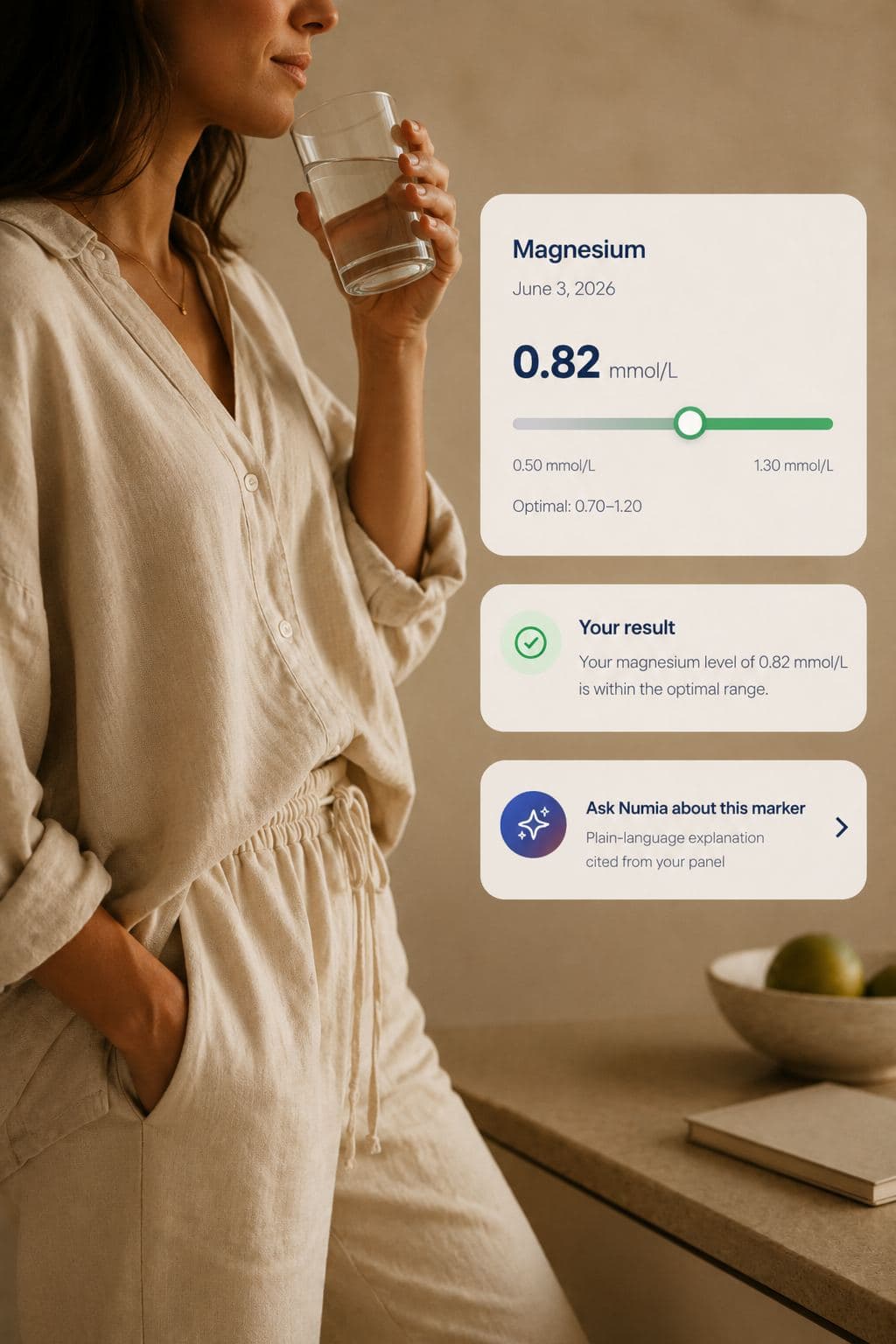
Numia Health brings the usual steps (an appointment, a lab visit, a wait, another appointment for results) into one place. A licensed Canadian physician approves your requisition online in about three minutes, and a clinician comes to your home in Greater Vancouver for a 10-minute morning draw. The Cardiac / Inflammatory panel measures eight markers (what they mean). Plain-English results reach the Numia app in 7 days, where the Numia Companion, an AI that has read them, answers questions. Out-of-range results are physician-reviewed with next steps, and an optional wellness consultation is available. Numia is an HSA-eligible service.
Frequently asked questions
At what age should you get your cholesterol checked in Canada?
At 40 for most adults, or at menopause if earlier, and sooner with risk factors like diabetes, smoking or early heart disease in the family. For a baseline before then, Numia offers a physician-approved panel.
Should children have their cholesterol checked?
Yes. The Canadian Paediatric Society's 2026 statement recommends checking every child between 2 and 10, mainly to find familial hypercholesterolemia, an inherited cause of high LDL. A family doctor or pediatrician arranges it.
How often should adults have their cholesterol checked?
BC's guideline says every 1 to 5 years, by risk; PEER's says every 5 to 10. The Numia app keeps every result together, so the trend is easy to see.
Sources7 references
- Babadagli, H. E., Barry, A. R., Thanassoulis, G., & Pearson, G. J. (2023). Updated guidelines for the management of dyslipidemia and the prevention of cardiovascular disease in adults by pharmacists. Canadian Pharmacists Journal, 156(3), 117–127. View source
- Blinkhorn, L., & Buelt, A. (2024). Lipid management: Guidelines from the Canadian PEER group for primary care. American Family Physician, 109(6), 583–584. View source
- Guidelines and Protocols Advisory Committee. (2021). Cardiovascular disease – primary prevention (updated 2023). BC Guidelines. British Columbia Ministry of Health. View source
- Khoury, M., Bigras, J.-L., Cummings, E. A., Harris, K. C., Hegele, R. A., Henderson, M., Morrison, K. M., St-Pierre, J., Wong, P. D., & McCrindle, B. W. (2026). Dyslipidemia in children: Diagnosis, evaluation, and management. Paediatrics & Child Health, 31(4), 392–399. View source
- Navar-Boggan, A. M., Peterson, E. D., D'Agostino, R. B., Sr., Neely, B., Sniderman, A. D., & Pencina, M. J. (2015). Hyperlipidemia in early adulthood increases long-term risk of coronary heart disease. Circulation, 131(5), 451–458. View source
- Numia Health. (n.d.). Cardiac / Inflammatory Panel. Retrieved September 25, 2026, from View source
- Strong, J. P., Malcom, G. T., McMahan, C. A., Tracy, R. E., Newman, W. P., Herderick, E. E., & Cornhill, J. F. (1999). Prevalence and extent of atherosclerosis in adolescents and young adults: Implications for prevention from the Pathobiological Determinants of Atherosclerosis in Youth Study. JAMA, 281(8), 727–735. View source
Last updated October 25, 2026