The best thyroid panel when your TSH is normal but your symptoms aren't

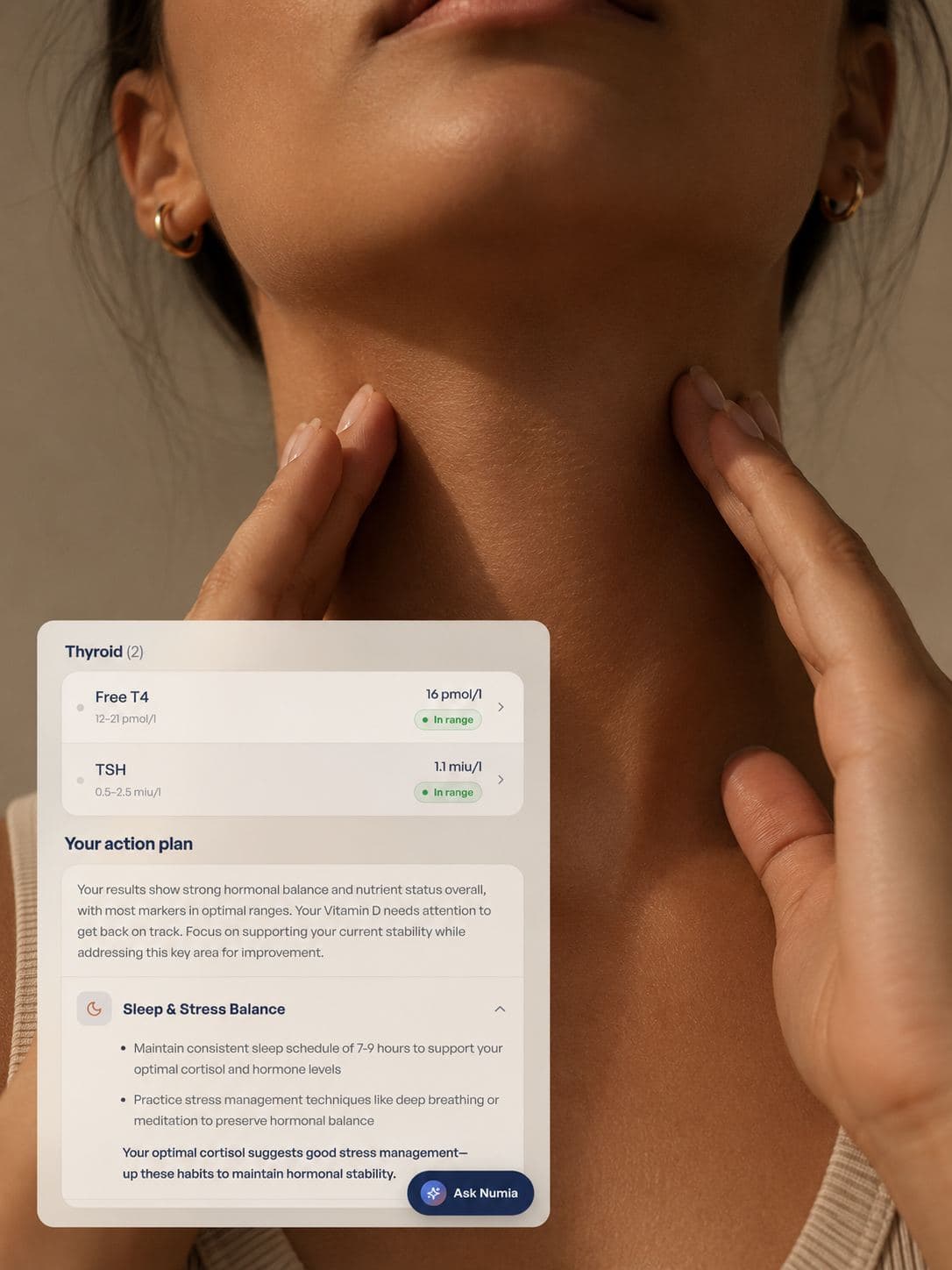
The best thyroid panel when your TSH is normal but your symptoms aren't is TSH with free T4 and free T3: the pituitary's signal plus the two hormones it controls. Together they give you the complete picture and a baseline to compare against later.
A normal TSH is good news: BC's guideline says it "excludes the majority of cases of primary thyroid dysfunction." Free T4 covers the uncommon cases where the pituitary isn't sending a reliable signal, and Numia's Thyroid Basic Panel measures all three in one home draw.
Why test the full picture if TSH is normal?
Because thyroid problems are common and easy to miss. When researchers pooled European studies, about 6.7% of people had thyroid dysfunction that hadn't been diagnosed. In US survey data, 80% of people with thyroid dysfunction didn't have a diagnosis. Symptoms like tiredness overlap with so much else that a blood test is needed to know for sure.
What does each thyroid test tell you?
| Test | What it shows | On Thyroid Basic? |
|---|---|---|
| TSH | The pituitary's signal; the first and main monitoring test | Yes |
| Free T4 | The main thyroid hormone; covers pituitary causes TSH can miss | Yes |
| Free T3 | The active hormone your cells use | Yes |
| TPO antibodies | Signs of thyroid autoimmunity (Hashimoto's) | No; your doctor can order it |
Why do BC labs usually stop at TSH?
BC's guidelines are written for a publicly funded system that has to prioritise clinically indicated tests. So if free T4 or free T3 is ordered with TSH, the lab cancels both when TSH is normal, unless a clinical reason applies, such as a suspected pituitary problem. Numia's Thyroid Basic Panel works differently: it reports free T4 and free T3 in every draw, whatever your TSH.
Why is a baseline worth having?
Thyroid function can change over the years. In an Australian study of 899 men aged 70 and older with normal thyroid tests, 1 in 5 had developed an underactive thyroid, mild or overt, about nine years later, and a higher starting TSH predicted who would. Numia's panel gives you all three numbers as a starting point.
What else could explain the symptoms?
Tiredness, weight gain and feeling cold have many possible causes. That's where Numia's Fatigue Panel helps: it has all three thyroid markers plus iron stores, B12, folate, blood sugar, and liver and kidney markers. You won't need both panels.
How does Numia work?
The usual route takes separate steps: appointment, lab visit, wait, then another appointment. Numia brings them together. A licensed Canadian physician approves your requisition online within 24 hours, a BC-licensed clinician visits your home for a morning draw, and plain-English results arrive in the Numia app in 7 days. Out-of-range results are physician-reviewed with next steps, and an optional wellness consultation lets you talk them through. Numia is an HSA-eligible service.
Frequently asked questions
Can I order a full thyroid panel myself in Canada, without a doctor's visit?
Yes, through a private service, though a physician still approves it; Numia's does so online within 24 hours. LifeLabs' BC online store showed no thyroid tests on 23 September 2026, and Blood Tests Canada lists no BC sites.
What's the best way to track free T4 and free T3 between appointments?
Retest the same way each time, and at least 6 weeks after any levothyroxine dose change, then yearly when stable. Numia measures all three every draw. Your prescriber doses mainly by TSH and makes every dosing decision.
How accurate is an at-home free T3 and free T4 test?
It depends on how the blood is collected. An ATA-commissioned review says finger-prick and dried-blood samples "require additional validation." Numia's clinician draws your blood at home, and it's analyzed at an accredited Canadian lab.
Sources13 references
- Blood Tests Canada. (n.d.). Thyroid blood analysis. Retrieved September 22, 2026, from View source
- Choosing Wisely Canada. (2019, April 9). Response from the Canadian Society of Endocrinology and Metabolism (CSEM). View source
- Garmendia Madariaga, A., Santos Palacios, S., Guillén-Grima, F., & Galofré, J. C. (2014). The incidence and prevalence of thyroid dysfunction in Europe: A meta-analysis. The Journal of Clinical Endocrinology & Metabolism, 99(3), 923–931. View source
- Gottwald-Hostalek, U., & Schulte, B. (2022). Low awareness and under-diagnosis of hypothyroidism. Current Medical Research and Opinion, 38(1), 59–64. View source
- Guidelines and Protocols Advisory Committee. (2018). Thyroid function testing in the diagnosis and monitoring of thyroid function disorder. BC Guidelines. British Columbia Ministry of Health. View source
- LifeLabs. (n.d.). LifeLabs Store, British Columbia [Search: thyroid]. Retrieved September 23, 2026, from View source
- LifeLabs. (2019, December 6). Notice of changes to thyroid testing processes in British Columbia. View source
- Numia Health. (n.d.). Home page. Retrieved September 24, 2026, from View source
- Numia Health. (n.d.). Thyroid Basic Panel. Retrieved September 24, 2026, from View source
- Tan, S. Y., Chubb, S. A. P., Flicker, L., Almeida, O. P., Golledge, J., Hankey, G. J., & Yeap, B. B. (2024). Changes in thyroid function and evolution of subclinical thyroid disease in older men. Clinical Endocrinology, 100(2), 170–180. View source
- Van Uytfanghe, K., Ehrenkranz, J., Halsall, D., Hoff, K., Loh, T. P., Spencer, C. A., & Köhrle, J. (2023). Thyroid stimulating hormone and thyroid hormones (triiodothyronine and thyroxine): An American Thyroid Association-commissioned review of current clinical and laboratory status. Thyroid, 33(9), 1013–1028. View source
- Wintemute, K., Greiver, M., McIsaac, W., Del Giudice, M. E., Sullivan, F., Aliarzadeh, B., Kalia, S., Meaney, C., Moineddin, R., & Singer, A. (2019). Choosing Wisely Canada campaign associated with less overuse of thyroid testing: Retrospective parallel cohort study. Canadian Family Physician, 65(11), e487–e496. View source
- Zhang, X., Wang, Y., Wang, H., & Zhang, X. (2024). Trends in prevalence of thyroid dysfunction and its associations with mortality among US participants, 1988–2012. The Journal of Clinical Endocrinology & Metabolism, 109(2), e657–e666. View source
Last updated September 30, 2026