How to tell whether your thyroid dose is right when the weight won't shift
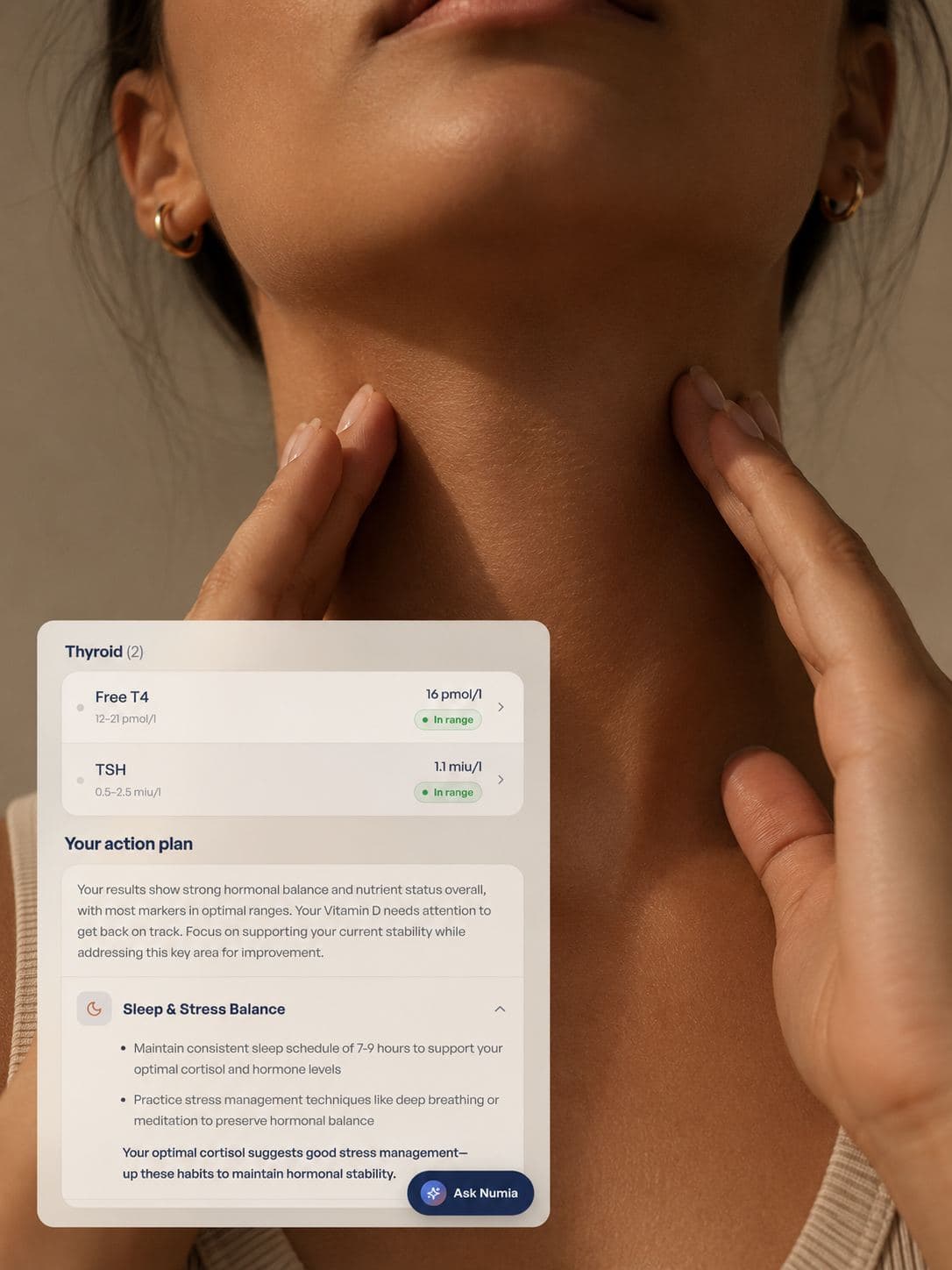
You can tell whether your thyroid dose is right mainly from your TSH: if it's back inside the lab's reference range, your dose is meeting the target your prescriber doses by. If the weight still won't budge, the dose is usually only part of the story.
TSH, or thyroid-stimulating hormone, is the signal your pituitary gland sends to your thyroid. It climbs when thyroid hormone runs low and falls when there's too much. Numia's Thyroid Basic Panel measures it alongside free T4 and free T3, the hormones themselves. Whether to change your dose is your prescriber's decision.
How often should TSH be rechecked?
| Situation | Usual recheck |
|---|---|
| Started levothyroxine or changed the dose | At least 6 weeks later |
| Dose stable, TSH in range | Once a year, unless something changes |
| New medication, pregnancy, big change in weight or health | Sooner, on your prescriber's schedule |
Levels take about 6 weeks to settle after a change, and TSH can shift by up to 40% between tests with no real change in your thyroid. That's why your own trend matters. In a study that tested 16 healthy men monthly for a year, each man's own range was about half as wide as the lab's reference range. A personal baseline helps you spot real change.
How much weight is the thyroid actually responsible for?
Less than most people expect. The American Thyroid Association (ATA) puts thyroid-related gain at about 5–10 pounds, mostly salt and water. In one small study of 12 newly diagnosed patients, weight fell from 83.7 to 79.4 kg on treatment while fat mass was "virtually unchanged." If your energy improves but the scale doesn't, the ATA says the weight probably wasn't only thyroid.
Here's the catch: more thyroid hormone isn't a shortcut. BC's guideline warns that overtreatment can cause an irregular heartbeat (atrial fibrillation) and bone loss in postmenopausal women. If weight is your bigger question, Numia's Weight Loss Monitoring panel adds blood sugar, lipids, and liver and kidney markers.
Where do free T4 and free T3 fit?
Free T4 and free T3 complete the picture: free T4 is the main hormone your thyroid makes, and free T3 is the active form your cells use. Numia measures both in every Thyroid Basic draw. For dose changes, though, Canadian endocrinologists advise going by TSH unless the pituitary or hypothalamus is involved. Free T4 briefly rises after a dose, so ask your prescriber how to time your pill.
How does Numia make retesting simpler?
The usual route runs in steps: an appointment, a lab visit, a wait, then another appointment for results. Your prescriber can order a TSH with public funding. Numia keeps every step in one place: a licensed Canadian physician approves your requisition online within 24 hours, a BC-licensed clinician comes to your home for a morning draw, and plain-English results reach the Numia app in 7 days. Numia is an HSA-eligible service. Any dose change stays with your prescriber.
Frequently asked questions
Can my TSH be normal and my thyroid still be the reason I feel awful?
It's uncommon but possible. BC's guideline says a normal TSH "excludes the majority of cases of primary thyroid dysfunction." The main exception, a pituitary cause, shows up as low free T4, which Numia measures every time. Your physician interprets results.
Why did my blood test only check TSH, and can I get free T4 and free T3 too?
BC's requisition starts every thyroid option with TSH, and labs add free T4 when TSH is abnormal or a clinical reason applies. It's built for a publicly funded system. Numia's Thyroid Basic Panel measures all three, every time.
Can I take more thyroid medication to lose weight?
No. The ATA warns extra thyroid hormone raises the risk of serious side effects, and the weight usually returns. Dose changes are your prescriber's call.
Sources12 references
- American Thyroid Association. (n.d.). Thyroid and weight. Retrieved September 22, 2026, from View source
- Andersen, S., Pedersen, K. M., Bruun, N. H., & Laurberg, P. (2002). Narrow individual variations in serum T4 and T3 in normal subjects: A clue to the understanding of subclinical thyroid disease. The Journal of Clinical Endocrinology & Metabolism, 87(3), 1068–1072. View source
- British Columbia Ministry of Health. (2026). Standard out-patient laboratory requisition (HLTH 1901, rev. 2026/05/15). View source
- Choosing Wisely Canada. (2019, April 9). Response from the Canadian Society of Endocrinology and Metabolism (CSEM). View source
- Guidelines and Protocols Advisory Committee. (2018). Thyroid function testing in the diagnosis and monitoring of thyroid function disorder. BC Guidelines. British Columbia Ministry of Health. View source
- Jonklaas, J., Bianco, A. C., Bauer, A. J., Burman, K. D., Cappola, A. R., Celi, F. S., Cooper, D. S., Kim, B. W., Peeters, R. P., Rosenthal, M. S., & Sawka, A. M. (2014). Guidelines for the treatment of hypothyroidism: Prepared by the American Thyroid Association Task Force on Thyroid Hormone Replacement. Thyroid, 24(12), 1670–1751. View source
- Karmisholt, J., Andersen, S., & Laurberg, P. (2011). Weight loss after therapy of hypothyroidism is mainly caused by excretion of excess body water associated with myxoedema. The Journal of Clinical Endocrinology & Metabolism, 96(1), E99–E103. View source
- Numia Health. (n.d.). Home page. Retrieved September 24, 2026, from View source
- Numia Health. (n.d.). Thyroid Basic Panel. Retrieved September 24, 2026, from View source
- Stoll, K. (2019). Disparities in thyroid screening and medication use in Quebec, Canada. Health Equity, 3(1), 328–335. View source
- Therapeutics Initiative. (2025, April 22). Thyroid testing in primary hypothyroidism (Therapeutics Letter No. 154). University of British Columbia. View source
- Van Uytfanghe, K., Ehrenkranz, J., Halsall, D., Hoff, K., Loh, T. P., Spencer, C. A., & Köhrle, J. (2023). Thyroid stimulating hormone and thyroid hormones (triiodothyronine and thyroxine): An American Thyroid Association-commissioned review of current clinical and laboratory status. Thyroid, 33(9), 1013–1028. View source
Last updated September 29, 2026