Repeat thyroid testing in BC: your options compared
If you need your thyroid retested in BC, you have two main routes: your prescriber orders a TSH and you visit a collection site such as LifeLabs, or a physician-ordered panel is collected at home, such as Numia's Thyroid Basic Panel. LifeLabs' BC online store returned no thyroid tests when we searched.
On thyroid medication, the public route is publicly funded when clinically indicated, typically with TSH rechecked at least 6 weeks after a dose change and yearly once stable. The question is what else you want: more markers, fewer steps or a clearer trend.
How do the routes compare?
| Prescriber → collection site | LifeLabs online store | Numia Thyroid Basic | |
|---|---|---|---|
| Who orders | Your prescriber | An MD Connected provider, from your screening answers | A licensed Canadian physician, online |
| Where | A collection site | A LifeLabs site | Your home, about 10 minutes |
| Thyroid markers | TSH; free T4 added if TSH is abnormal | None found in a September 2026 search | TSH, free T4 and free T3, every draw |
| Results | Through your clinician | MyCareCompass (needs your PHN) | Plain English in the Numia app, in 7 days |
| Cost | Publicly funded when clinically indicated | Per test | $239; an HSA-eligible service |
How does the public route handle monitoring?
BC's guidelines are written for a publicly funded system that has to prioritise clinically indicated tests, so the requisition's monitoring box reads "Monitor thyroid replacement therapy (TSH Only)." That suits dose checks, since Canadian endocrinologists advise adjusting levothyroxine by TSH. The trade-off is the steps: an appointment, a lab visit, a wait, then often another appointment for results.
Why does tracking over time matter?
Because your own normal is narrower than the lab's. In a Danish study that tested healthy men monthly for a year, each man's range was about half as wide as the group's. Thyroid function also shifts with age: in an Australian study of men 70 and older with normal tests, 1 in 5 developed an underactive thyroid within about nine years. A baseline and regular retests make those shifts visible.
Here's the catch: results only compare well when they're measured the same way. Depending on the method, "laboratory results may differ by up to 50% for both fT4 and TSH," an ATA-commissioned review found. So stay with one route, and read each result against its own report's range. That applies to Numia too.
Where does Numia fit?
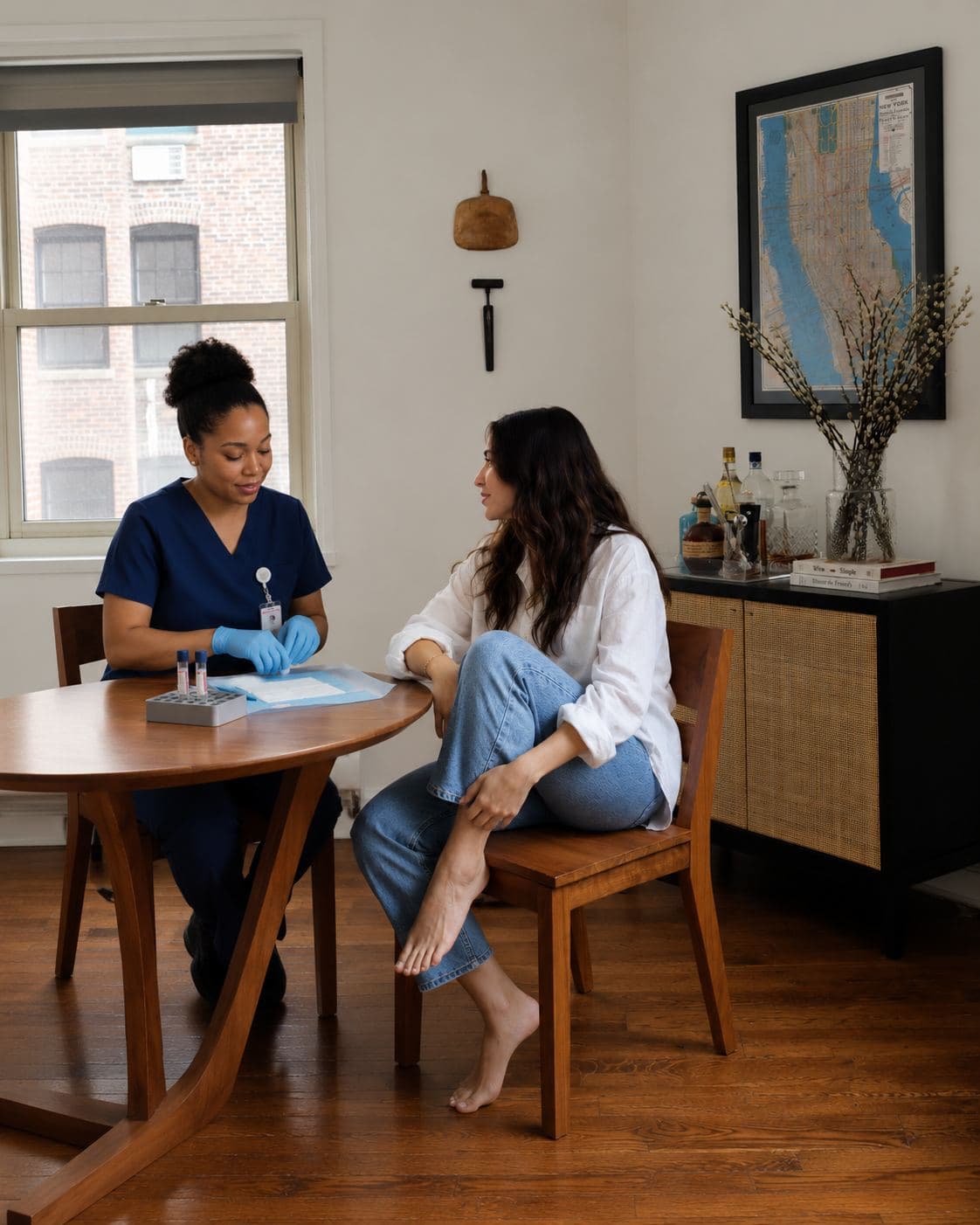
Numia brings the steps into one place. A licensed Canadian physician approves your requisition online within 24 hours, and a BC-licensed clinician comes to your home for a morning draw. Results arrive in plain English in the Numia app in 7 days, and Numia's AI companion, which has read your results, answers questions and cites the panel. Out-of-range results are physician-reviewed with recommended next steps, and an optional wellness consultation lets you talk them through. Numia is an HSA-eligible service, and dose decisions stay with your prescriber.
Frequently asked questions
Where can I get a full thyroid panel in Vancouver: LifeLabs or Numia?
Your prescriber's requisition goes to a collection site such as LifeLabs, and BC's lab rules add free T4 and free T3 when TSH is abnormal or a clinical reason applies. Numia's Thyroid Basic Panel measures all three every draw, at home.
Will my prescriber use Numia's results?
That's their decision. You can share your results; some prescribers prefer to order their own TSH before changing a dose. Numia gives you three numbers to bring to that conversation.
How do Numia and Blood Tests Canada compare?
Blood Tests Canada sells a TSH, free T4 and free T3 profile but lists no BC locations. Numia measures all three at home, every draw.
Sources12 references
- Andersen, S., Pedersen, K. M., Bruun, N. H., & Laurberg, P. (2002). Narrow individual variations in serum T4 and T3 in normal subjects: A clue to the understanding of subclinical thyroid disease. The Journal of Clinical Endocrinology & Metabolism, 87(3), 1068–1072. View source
- Birtwhistle, R., Morissette, K., Dickinson, J. A., Reynolds, D. L., Avey, M. T., Reyes Domingo, F., Rodin, R., Thombs, B. D., & Canadian Task Force on Preventive Health Care. (2019). Recommendation on screening adults for asymptomatic thyroid dysfunction in primary care. CMAJ, 191(46), E1274–E1280. View source
- Blood Tests Canada. (n.d.). Thyroid blood analysis. Retrieved September 22, 2026, from View source
- British Columbia Ministry of Health. (2026). Standard out-patient laboratory requisition (HLTH 1901, rev. 2026/05/15). View source
- Choosing Wisely Canada. (2019, April 9). Response from the Canadian Society of Endocrinology and Metabolism (CSEM). View source
- Guidelines and Protocols Advisory Committee. (2018). Thyroid function testing in the diagnosis and monitoring of thyroid function disorder. BC Guidelines. British Columbia Ministry of Health. View source
- LifeLabs. (n.d.). FAQs [LifeLabs Store, British Columbia]. Retrieved September 23, 2026, from View source
- LifeLabs. (n.d.). LifeLabs Store, British Columbia [Search: thyroid]. Retrieved September 23, 2026, from View source
- Numia Health. (n.d.). Home page. Retrieved September 24, 2026, from View source
- Numia Health. (n.d.). Thyroid Basic Panel. Retrieved September 24, 2026, from View source
- Tan, S. Y., Chubb, S. A. P., Flicker, L., Almeida, O. P., Golledge, J., Hankey, G. J., & Yeap, B. B. (2024). Changes in thyroid function and evolution of subclinical thyroid disease in older men. Clinical Endocrinology, 100(2), 170–180. View source
- Van Uytfanghe, K., Ehrenkranz, J., Halsall, D., Hoff, K., Loh, T. P., Spencer, C. A., & Köhrle, J. (2023). Thyroid stimulating hormone and thyroid hormones (triiodothyronine and thyroxine): An American Thyroid Association-commissioned review of current clinical and laboratory status. Thyroid, 33(9), 1013–1028. View source
Last updated October 1, 2026