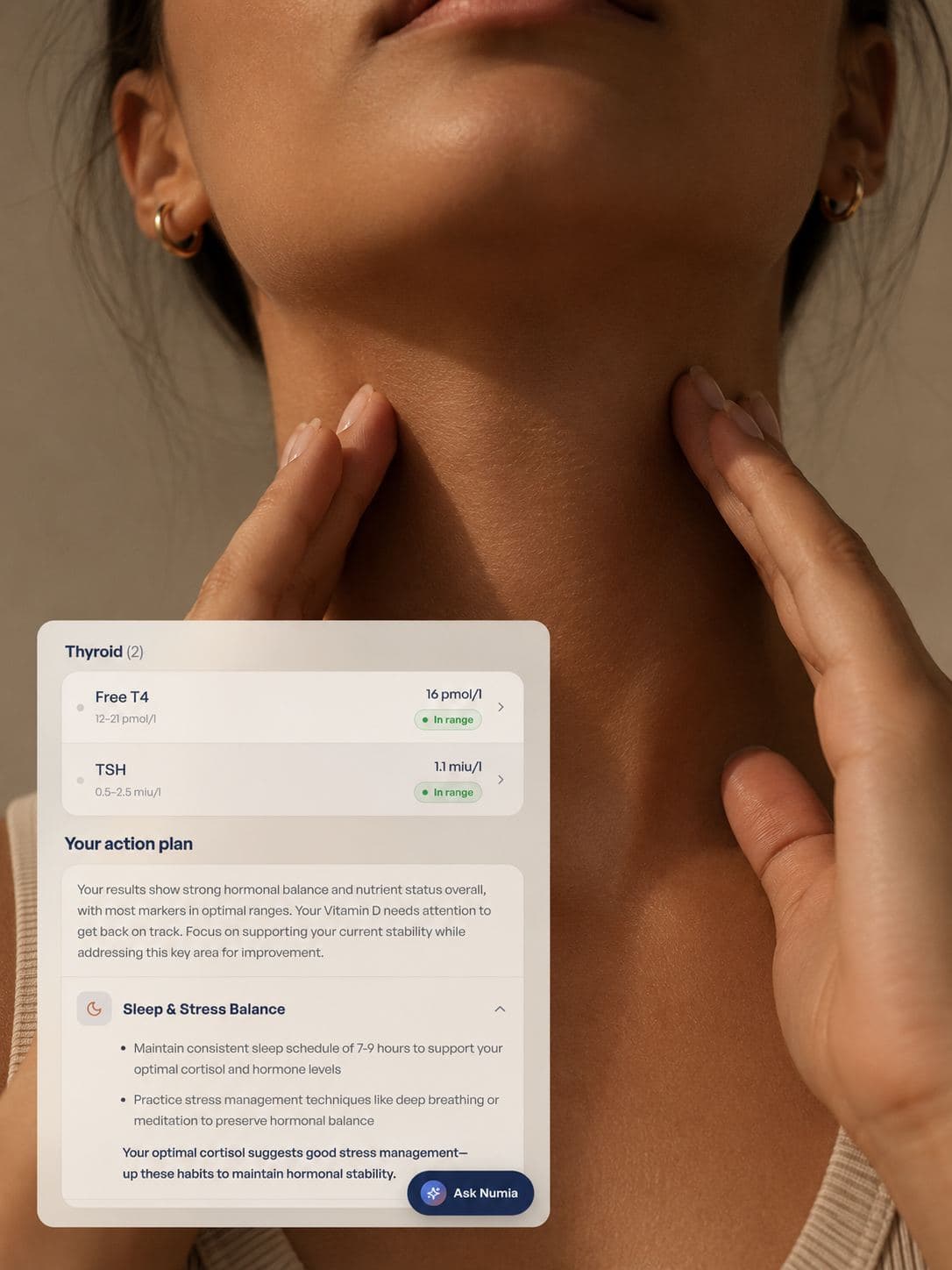
Normal TSH levels by age: the upper limit climbs from about 3.6 mIU/L in your 20s to 7.5 mIU/L after 80
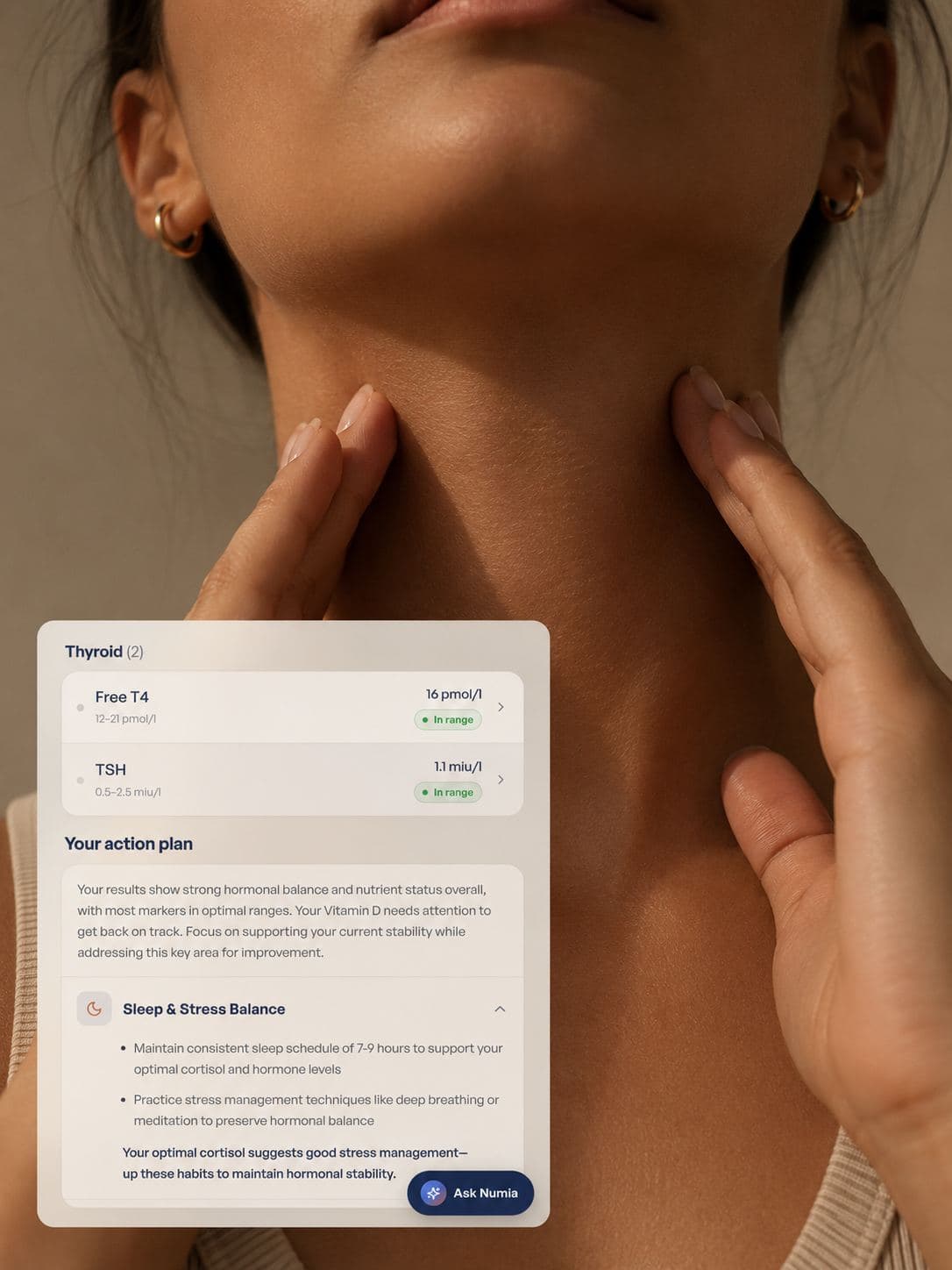
A normal TSH rises with age: in healthy adults, the upper end climbs from about 3.56 mIU/L in your 20s to 7.49 mIU/L after 80, even though most lab reports print a single adult range.
TSH, or thyroid-stimulating hormone, is the signal your pituitary gland sends to your thyroid. Free T4 and free T3, the thyroid hormones themselves, complete the picture, and Numia's Thyroid Basic panel reports all three on every draw.
Here's the catch: printed ranges come from large groups, and your own range is narrower. In a Danish study of healthy men tested monthly for a year, each man's TSH and thyroid hormone ranges were about half as wide as the group's (Andersen et al., 2002). A baseline of your own makes later results easier to read.
What is a normal TSH level by age?
| Age or stage | TSH, mIU/L | Source |
|---|---|---|
| Birth to 8 days | 1.23–25.00 | Alberta |
| 8 days to 1 year | 1.00–6.80 | Alberta |
| 1 year and older | 0.20–6.50 | Alberta |
| Healthy adults, 20–29 | Upper end 3.56 | US survey |
| Healthy adults, 80+ | Upper end 7.49 | US survey |
| Pregnancy, 9–12 weeks | 0.1–3.0 | Calgary |
| Pregnancy, 28 weeks to term | 0.5–5.0 | Calgary |
Labs and methods differ, so read any result, Numia's included, against the range on its own report.
Why does TSH rise with age?
In US survey data from people without thyroid disease, TSH shifted upward with age: 40% of people aged 80 and over had a TSH above 2.5 mIU/L (Surks & Hollowell, 2007). A lab study of 465,593 results traced the rise mainly to a stronger night-time TSH surge (Ehrenkranz et al., 2015). For a mildly high result, see slightly high TSH, normal free T4.
Free T4 doesn't climb the same way: the same lab study found age didn't change its reference interval. Seeing TSH beside free T4 and free T3 puts a higher number in context; Numia's Thyroid Basic and Fatigue Panel report all three together, and Weight Loss Monitoring includes TSH.
Do pregnancy and time of day change a normal TSH?
Yes, both do. BC's thyroid guideline says first-trimester ranges run lower than the usual adult range, and TSH may dip when hCG, a pregnancy hormone, peaks. Thyroid care in pregnancy runs through your prenatal provider; see blood tests before trying to conceive.
TSH can also swing by 50% across the day, lowest in the late afternoon and highest around midnight, BC's guideline notes. Numia's home draws are morning appointments, so your repeat tests land at a similar hour (why that helps).
Where does Numia fit?
Numia Health, a physician-ordered, at-home blood testing service in Greater Vancouver, keeps the usual separate steps in one place. A licensed Canadian physician approves your requisition online in about 3 minutes, a BC-licensed clinician does a 10-minute morning draw at your home, and plain-English results arrive in the Numia app in 7 days. The Numia Companion, an AI that has read your results, answers questions, and out-of-range results are physician-reviewed with next steps. An optional wellness consultation is available, and Numia is an HSA-eligible service.
Frequently asked questions
Is there a normal TSH level by age chart?
Yes. Alberta's lab uses 0.20–6.50 mIU/L from age one, while in healthy US adults the upper end rises from 3.56 at 20–29 to 7.49 after 80.
What is the TSH normal reference range for older adults?
Usually the same adult range printed for everyone, though healthy older adults run higher: the upper end reaches 7.49 mIU/L after 80 in US data. A yearly Numia baseline shows your own trend.
Do children have higher TSH than adults?
Yes. In the Canadian Health Measures Survey (2022–2024), median TSH was 2.01 mIU/L at ages 3–5, against 1.51 mIU/L at 20–39.
Sources9 references
- Alberta Health Services. (n.d.). Thyroid function assessment & monitoring in women of child-bearing age [Calgary Zone clinical pathway]. Retrieved September 22, 2026, from View source
- Alberta Precision Laboratories & DynaLIFE Medical Labs. (2022, June 13). Update to thyroid hormone reference intervals and to the progressive TSH algorithm [Laboratory bulletin]. View source
- Andersen, S., Pedersen, K. M., Bruun, N. H., & Laurberg, P. (2002). Narrow individual variations in serum T4 and T3 in normal subjects: A clue to the understanding of subclinical thyroid disease. The Journal of Clinical Endocrinology & Metabolism, 87(3), 1068–1072. View source
- Ehrenkranz, J., Bach, P. R., Snow, G. L., Schneider, A., Lee, J. L., Ilstrup, S., Bennett, S. T., & Benvenga, S. (2015). Circadian and circannual rhythms in thyroid hormones: Determining the TSH and free T4 reference intervals based upon time of day, age, and sex. Thyroid, 25(8), 954–961. View source
- Guidelines and Protocols Advisory Committee. (2018). Thyroid function testing in the diagnosis and monitoring of thyroid function disorder. BC Guidelines. British Columbia Ministry of Health. View source
- Numia Health. (n.d.). Fatigue Panel. Retrieved September 25, 2026, from View source
- Numia Health. (n.d.). Thyroid Basic Panel. Retrieved September 25, 2026, from View source
- Numia Health. (n.d.). Weight Loss Monitoring Panel. Retrieved September 25, 2026, from View source
- Surks, M. I., & Hollowell, J. G. (2007). Age-specific distribution of serum thyrotropin and antithyroid antibodies in the US population: Implications for the prevalence of subclinical hypothyroidism. The Journal of Clinical Endocrinology & Metabolism, 92(12), 4575–4582. View source
Last updated October 28, 2026