Hyperthyroidism blood tests and symptoms: a low TSH with a high free T4 or free T3

Hyperthyroidism shows up on blood tests as a low TSH with a high free T4, a high free T3, or both, and its common symptoms include a racing heartbeat, weight loss despite eating normally, tremor, feeling hot, anxiety and more frequent bowel movements.
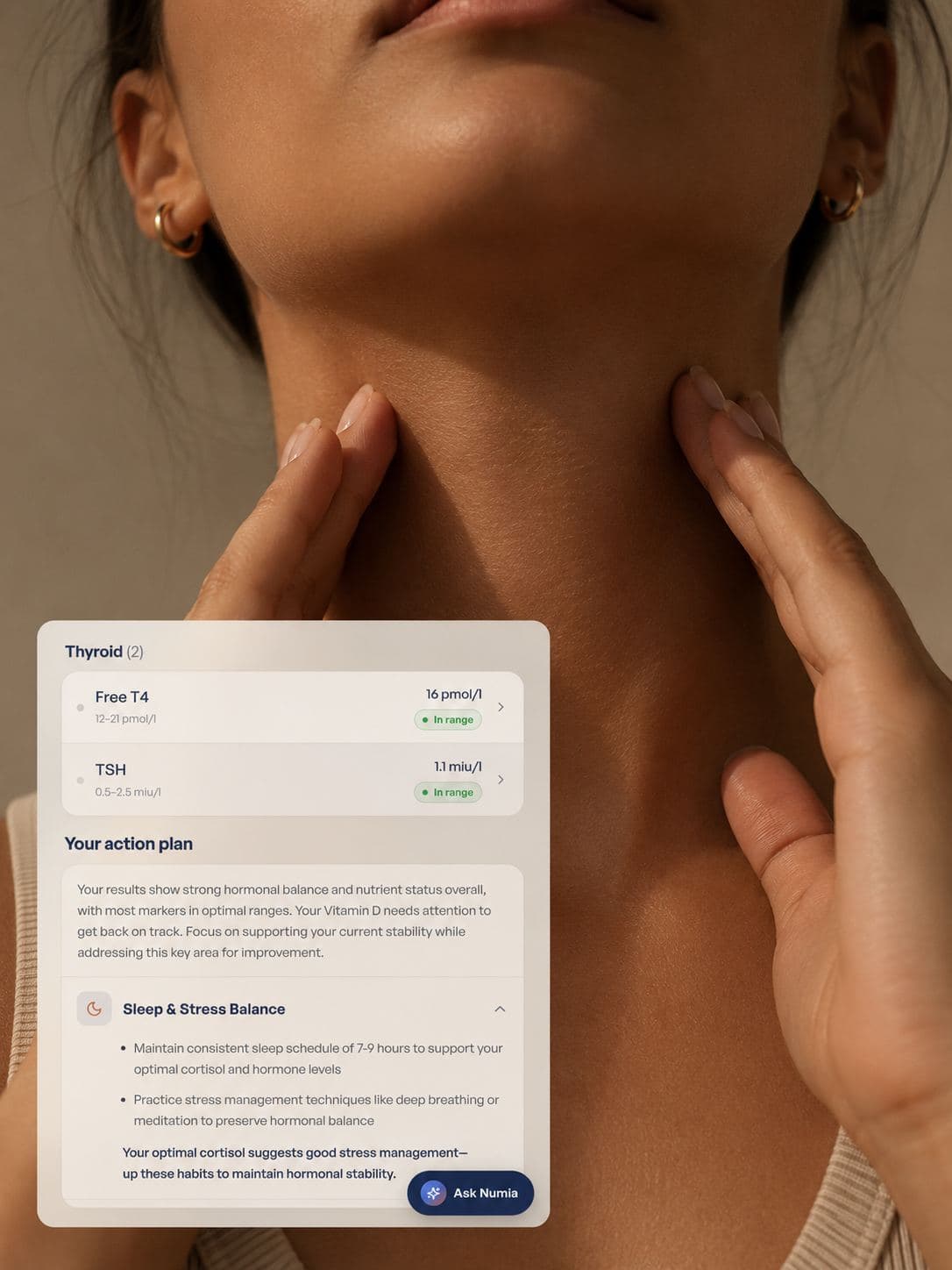
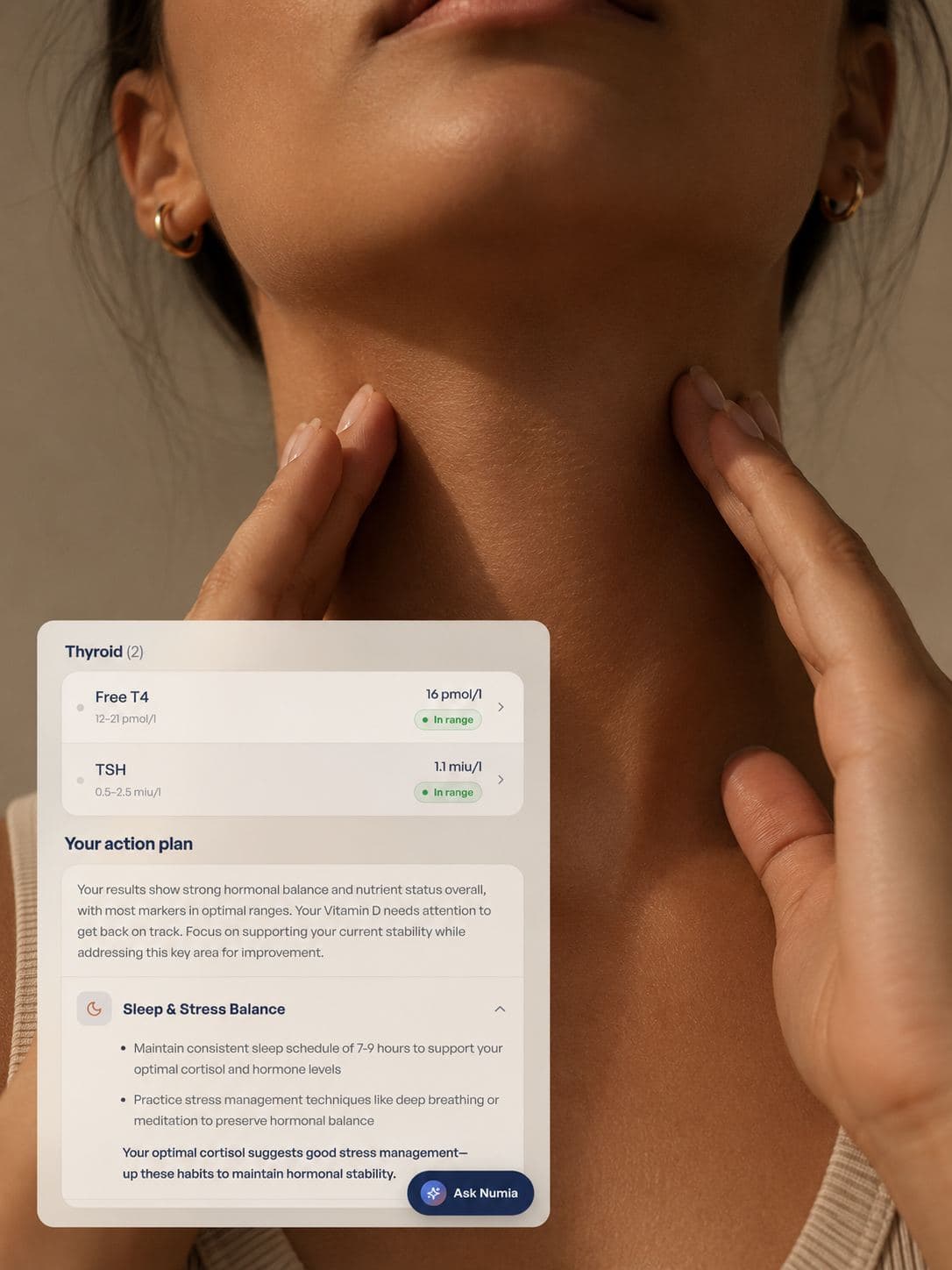
TSH is the signal your pituitary gland sends to your thyroid. When the thyroid overproduces, TSH falls while free T4 and free T3, the hormones themselves, rise. Seeing all three together gives the complete picture, and Numia's Thyroid Basic panel reports them on every draw.
Hyperthyroidism can also go unnoticed: in pooled European studies, about 1.7% of people had undiagnosed hyperthyroidism (Garmendia Madariaga et al., 2014).
When are hyperthyroidism symptoms urgent?
When to seek care now: HealthLink BC advises calling 9-1-1 immediately for serious signs of thyroid storm, such as shock or delirium. For people already diagnosed with hyperthyroidism, it advises calling a doctor now for a very fast heartbeat or chest pain, fever, confusion, vomiting or diarrhea, or trouble breathing. These can't wait for a blood test, Numia's included.
BC's thyroid guideline also lists restless sleep, muscle weakness, hair loss, an irregular heartbeat, infrequent or missed periods and eye changes such as bulging.
Which blood tests show hyperthyroidism?
| Pattern | TSH | Free T4 | Free T3 | Common causes |
|---|---|---|---|---|
| Overt | Low | High | High or normal | Graves' disease, nodules, thyroiditis, too much levothyroxine |
| T3 thyrotoxicosis | Low | Normal or low | High | An overactive nodule; too much liothyronine or desiccated thyroid |
| Subclinical | Low | Normal | Normal | Recovering hyperthyroidism, early pregnancy, lab interference |
BC's standard lab form has a "Suspected Hyperthyroidism" option: TSH first, with free T4 and free T3 added if indicated. Numia's Thyroid Basic and Fatigue Panel report all three on every draw, so a high free T3 with a normal free T4 shows on the same report.
What causes hyperthyroidism?
Graves' disease, an autoimmune condition, is the most common cause, affecting about 2% of women and 0.5% of men worldwide. Others include overactive nodules, thyroiditis (inflammation of the thyroid), the heart drug amiodarone and too much thyroid medication.
The Graves' marker, TSH receptor antibodies, isn't on Numia's panels; your physician can order it. If you take levothyroxine, a low TSH is a dose question for your prescriber (thyroid dose and TSH). Treatment (antithyroid drugs, radioactive iodine or surgery) is your physician's call.
Where does Numia fit?
Numia Health, a physician-ordered, at-home blood testing service in Greater Vancouver, keeps the usual steps in one place. A licensed Canadian physician approves your requisition online in about 3 minutes, a BC-licensed clinician does a 10-minute morning draw at your home, and plain-English results arrive in the Numia app in 7 days. The Numia Companion, an AI that has read your results, answers questions, and out-of-range results are physician-reviewed with next steps. An optional wellness consultation is available, and Numia is an HSA-eligible service that sells testing, not treatment.
Frequently asked questions
What blood tests are used for hyperthyroidism, and what are the symptoms?
TSH, free T4 and free T3 together show the pattern: TSH low, with one or both hormones high. Symptoms include palpitations, weight loss, tremor, feeling hot, anxiety and frequent stools. Numia's Thyroid Basic panel reports all three; a clinician makes any diagnosis.
Can you have a low TSH without hyperthyroidism?
Yes. Causes in BC's guideline include recovery from hyperthyroidism, early pregnancy, serious illness, lab interference from high-dose biotin and too much thyroid medication. Free T4 and free T3, on every Numia Thyroid Basic draw, help tell these apart. See normal TSH levels by age.
Is a slightly low TSH the same as hyperthyroidism?
Not necessarily. A low TSH with normal free T4 and free T3 is called subclinical hyperthyroidism. Treatment is considered mainly in older adults or when TSH is below 0.1 mIU/L, and that's your physician's decision.
Sources8 references
- British Columbia Ministry of Health. (2026). Standard out-patient laboratory requisition (HLTH 1901, rev. 2026/05/15). View source
- Garmendia Madariaga, A., Santos Palacios, S., Guillén-Grima, F., & Galofré, J. C. (2014). The incidence and prevalence of thyroid dysfunction in Europe: A meta-analysis. The Journal of Clinical Endocrinology & Metabolism, 99(3), 923–931. View source
- Guidelines and Protocols Advisory Committee. (2018). Thyroid function testing in the diagnosis and monitoring of thyroid function disorder. BC Guidelines. British Columbia Ministry of Health. View source
- HealthLink BC. (2023, March 1). Hyperthyroidism [Healthwise]. Retrieved September 22, 2026, from View source
- Lee, S. Y., & Pearce, E. N. (2023). Hyperthyroidism: A review. JAMA, 330(15), 1472–1483. View source
- Numia Health. (n.d.). Fatigue Panel. Retrieved September 25, 2026, from View source
- Numia Health. (n.d.). Thyroid Basic Panel. Retrieved September 25, 2026, from View source
- Tsadok, M. A., Jackevicius, C. A., Rahme, E., Essebag, V., Eisenberg, M. J., Humphries, K. H., Tu, J. V., Behlouli, H., Joo, J., & Pilote, L. (2011). Amiodarone-induced thyroid dysfunction: Brand-name versus generic formulations. CMAJ, 183(12), E817–E823. View source
Last updated October 29, 2026