A slightly high TSH with a normal free T4 usually means subclinical hypothyroidism, and the first step is a repeat test
A slightly high TSH with a normal free T4 usually means subclinical hypothyroidism, a mildly underactive thyroid, and the first step is a repeat test of TSH and free T4, typically in 2 to 3 months, because some mild rises settle on their own.
TSH is the pituitary's signal to your thyroid, and it climbs when thyroid hormone runs low. In subclinical hypothyroidism, TSH sits above the lab's upper limit, usually under 10 mIU/L, while free T4 stays in range. BC's guideline puts it at 4.3% to 8.5% of the general population, often with no symptoms or vague ones.
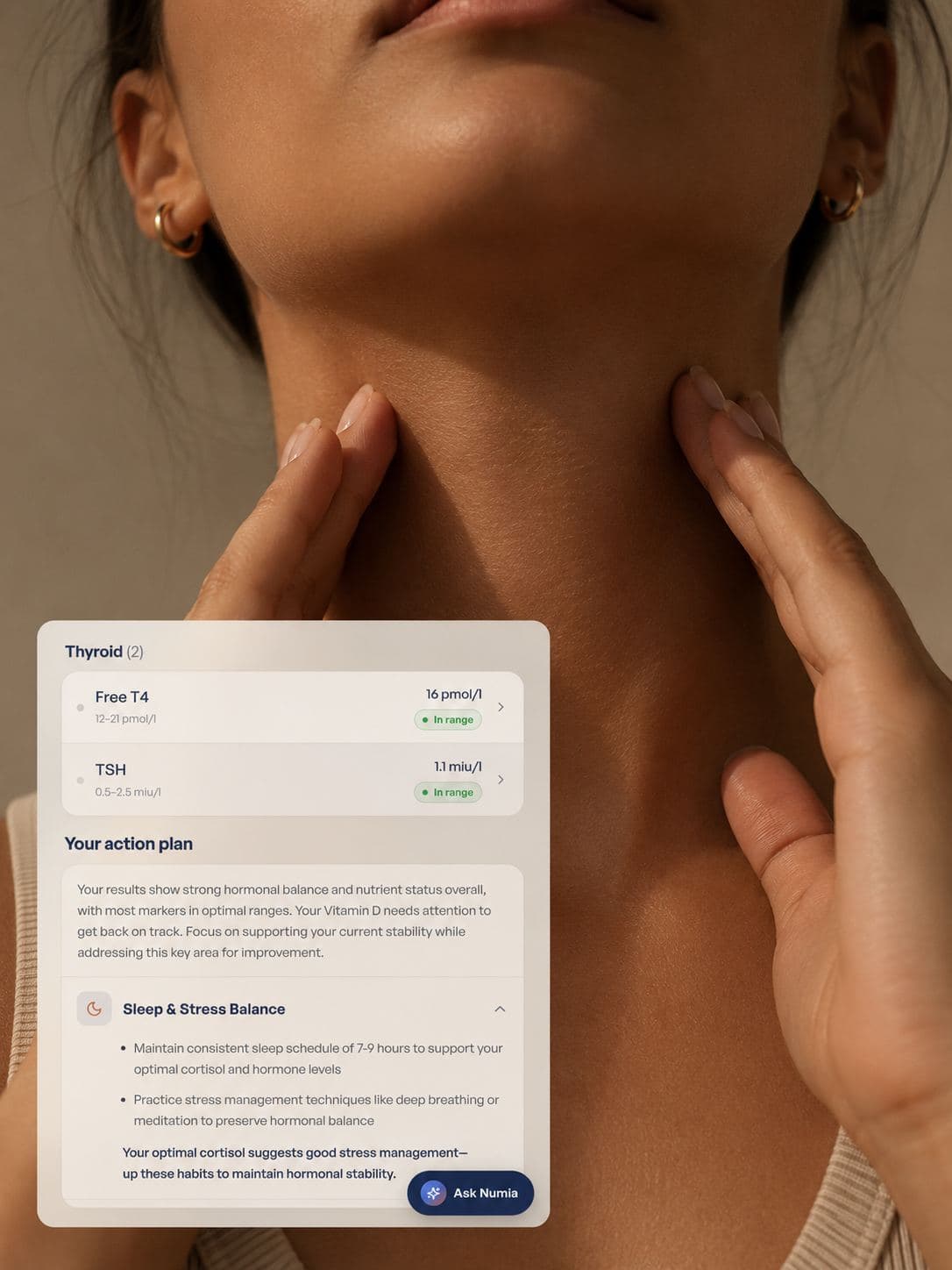
Repeating TSH with free T4 and free T3 gives you the complete picture and a trend; Numia's Thyroid Basic panel reports all three every draw.
Why repeat a slightly high TSH first?
One TSH result can mislead. BC's guideline notes TSH varies by time of day, can rise during recovery from illness, and can be skewed by high-dose biotin. Upper limits also vary by lab and age (normal TSH levels by age).
The 2013 European Thyroid Association guideline advises repeating TSH and free T4 "preferably after a 2- to 3-month interval." Numia's morning home draws keep each repeat at a similar hour.
When is treatment considered?
| Situation | Guidance |
|---|---|
| TSH above 10 mIU/L | Treatment recommended (BC, 2018) |
| Mildly high TSH (≤10), plus symptoms, TPO antibodies, heart risk or pregnancy | Treatment can be considered (BC, 2018) |
| Age 65+, TSH 4.60–19.99 mIU/L | No symptom or tiredness benefit at 1 year (TRUST trial) |
| Most adults, TSH up to 20, not trying to conceive | Strong recommendation against thyroid hormones (BMJ, 2019) |
Whether to treat is your physician's decision, and pregnancy has its own thresholds (blood tests before trying to conceive).
Why does tracking your TSH over time matter?
If a mildly high TSH stays high, BC's guideline suggests rechecking every 6 to 12 months if untreated. Some people progress to a fully underactive thyroid (overt hypothyroidism): 2.6% a year without TPO antibodies, a thyroid autoimmunity marker, and 4.3% with them. Regular rechecks, through your doctor or a Numia panel, turn single numbers into a trend.
Thyroid function can also drift with age: in an Australian study of men aged 70 and older with normal thyroid tests, 1 in 5 developed an underactive thyroid over about nine years, and a higher starting TSH predicted who would (Tan et al., 2024). Compare repeat thyroid testing options in BC.
Where does Numia fit?
Numia Health, a physician-ordered, at-home blood testing service in Greater Vancouver, keeps the usual steps in one place. A licensed Canadian physician approves your requisition online in about 3 minutes, a BC-licensed clinician does a 10-minute morning draw at your home, and plain-English results arrive in the Numia app in 7 days. The Numia Companion, an AI that has read your results, answers questions, and out-of-range results are physician-reviewed with next steps. An optional wellness consultation is available, and Numia is an HSA-eligible service that sells testing, not treatment.
Frequently asked questions
What does a slightly high TSH with a normal free T4 mean?
Usually subclinical hypothyroidism: TSH above your lab's upper limit, typically under 10 mIU/L, with free T4 in range. Guidelines suggest a repeat in 2 to 3 months before any decision. Numia's Thyroid Basic panel measures TSH, free T4 and free T3.
Should a mild TSH elevation from subclinical hypothyroidism be treated?
Often not. BC's guideline recommends treatment above 10 mIU/L; the TRUST trial and a 2019 BMJ guideline found no symptom benefit for most adults with TSH up to 20. Your physician decides; a Numia retest shows whether TSH is steady or rising.
Can subclinical hypothyroidism go away on its own?
Yes, sometimes. The European Thyroid Association says thyroid function may return to normal in 6% to 35% of people. Others progress to overt hypothyroidism, so regular rechecks matter; Numia's morning home draws keep them consistent.
Sources7 references
- Bekkering, G. E., Agoritsas, T., Lytvyn, L., Heen, A. F., Feller, M., Moutzouri, E., Abdulazeem, H., Aertgeerts, B., Beecher, D., Brito, J. P., Farhoumand, P. D., Singh Ospina, N., Rodondi, N., van Driel, M., Wallace, E., Snel, M., Okwen, P. M., Siemieniuk, R., Vandvik, P. O.. . . Vermandere, M. (2019). Thyroid hormones treatment for subclinical hypothyroidism: A clinical practice guideline. BMJ, 365, l2006. View source
- Guidelines and Protocols Advisory Committee. (2018). Thyroid function testing in the diagnosis and monitoring of thyroid function disorder. BC Guidelines. British Columbia Ministry of Health. View source
- Numia Health. (n.d.). Thyroid Basic Panel. Retrieved September 25, 2026, from View source
- Pearce, S. H. S., Brabant, G., Duntas, L. H., Monzani, F., Peeters, R. P., Razvi, S., & Wemeau, J.-L. (2013). 2013 ETA guideline: Management of subclinical hypothyroidism. European Thyroid Journal, 2(4), 215–228. View source
- Stott, D. J., Rodondi, N., Kearney, P. M., Ford, I., Westendorp, R. G. J., Mooijaart, S. P., Sattar, N., Aubert, C. E., Aujesky, D., Bauer, D. C., Baumgartner, C., Blum, M. R., Browne, J. P., Byrne, S., Collet, T.-H., Dekkers, O. M., den Elzen, W. P. J., Du Puy, R. S., Ellis, G.. . . TRUST Study Group. (2017). Thyroid hormone therapy for older adults with subclinical hypothyroidism. The New England Journal of Medicine, 376(26), 2534–2544. View source
- Symonds, C., Kline, G., Gjata, I., Rose, M. S., Guo, M., Cooke, L., & Naugler, C. (2020). Levothyroxine prescribing and laboratory test use after a minor change in reference range for thyroid-stimulating hormone. CMAJ, 192(18), E469–E475. View source
- Tan, S. Y., Chubb, S. A. P., Flicker, L., Almeida, O. P., Golledge, J., Hankey, G. J., & Yeap, B. B. (2024). Changes in thyroid function and evolution of subclinical thyroid disease in older men. Clinical Endocrinology, 100(2), 170–180. View source
Last updated October 30, 2026